Showing posts with label Indian ink. Show all posts

Sunday, 1 November 2020

INKTOBER 31st - Finished!

I managed to get my last page finished just before the stroke of midnight!

I much prefer the first side which is more cohesive. The background of the second side proved to be too busy and distracting, although it did make me experiment more with the ink based products in an effort to clarify the sketches.

The last page and title page (Uniball Eye pen plus gold gel pen)


The complete second side


The first side


The folded book giving me 32 sides measuring 4" x 6"

Tuesday, 27 October 2020

Inktober 23rd and 24th

I used Indian ink again on the lefthand image, using white gesso as a base for the flower and leaves to enable me to use a dip pen and acrylic ink to add detail and colour.  

For the other image I printed small lino cuts and foam stamps with ink-tinted gesso, adding line work with acrylic ink and gel pens.

Thank goodness it's nearly the end of the month - I'm beginning to run out of ideas for making my sketches stand out on this background.


Sunday, 25 October 2020

Inktober 21st - 22nd

 Some experiments in an effort to make my sketches stand out more on this painted background.

On the left, I painted Indian ink for the inset background, sketching on top with metallic gel pens.  This certainly made the image stand out.

On the right I used an underpainting of white gesso, drawing with a fine liner pen and adding colour with Inktense washes.


Monday, 30 March 2020

Sketchbook Revival - All Messed Up

Another gem from the Sketchbook Revival 2020 videos - Karen Stamper's "Wild Garden" in black and white.  I was particularly looking forward to this as I had found Karen's contribution last year inspiring and freeing.

Materials and techniques suggested were graphite, charcoal, candle wax, wax crayons, glue stick, torn paper stencils, leaf prints, ink (for drawing, spraying and wash), biro, markers, collage, etc.  The idea was to start with random graphite and charcoal, loose scribbles, areas of denser black with rubbed in crushed charcoal, resist marks with wax and glue stick, more charcoal, leaf shapes erased or sprayed through stencils, real leaf prints (directly on the page or collaged), finer lines with biro, inked lines with stick pen, etc.  All really wildly messy, but great fun.

I should probably have left more white areas - I did use white acrylic and then some gesso, but neither covered the charcoal as much as I would have liked.

The Tangled Hedge - mixed media in watercolour Moleskine 
Detail


Saturday, 1 June 2019

Urban Sketchers June

We had glorious weather for our June sketch meeting today.  Our venue was the small Wiltshire town of Cricklade - the first town situated on the River Thames as it flows, from its source, towards London.  Just outside the town are the water meadows which are famous for an extensive display of snake's head fritillaries in April.  A previous post gives details of the artists' book I made about this beautiful wild flower location.

Today, most of us opted to sketch in the tranquil surroundings of St. Sampson's Church.

Trying out a suggestion by (Karen Stamper) which I recently found on on the internet, I pre-prepared two pages of my watercolour Moleskine.  Torn strips of masking tape, labels, etc. were added, followed by random washes of Indian ink, walnut ink, a little orange fluid acrylic and areas of white gesso scraped on with a credit card.


Some of the masking tape has been removed, but a couple of the labels
threatened to tear the paper surface, so they were left in place

I chose to record this corner of the churchyard


A somewhat messy outcome (and a missing gable window!),
but a fun experiment
I used a fine liner pen, burnt sienna watercolour marker, black Pentel brush pen, watercolour, white gouache and oil pastels.  I'm not sure I will adopt the masking tape and label idea, but the dark background encouraged me to be bolder with my sketching in an attempt to bring the image out of the chaos.


Tuesday, 23 October 2018

Inktober 18th - 20th


Indian ink, white acrylic ink,
Pigma Micron pen and walnut ink

Tuesday, 15 May 2018

Recent gouache and ink resist painting

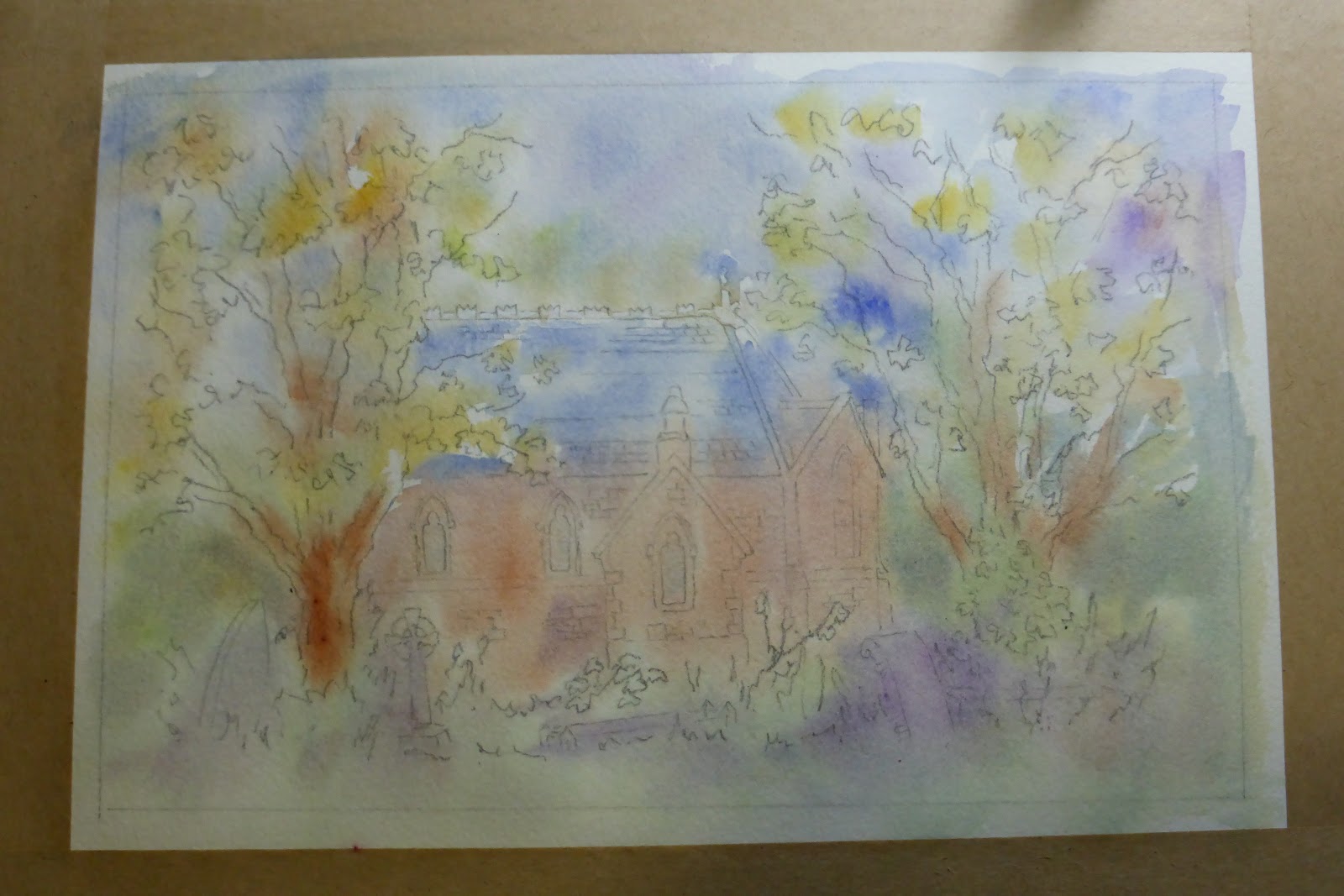
This painting has been languishing in my "unresolved" folder for over a month.  The original plein air sketch was done in November 2017, then earlier this year I followed it up with a postcard size sketch which prompted me to try an ink resist version.  I am still trying to decide if I want to take it any further.

Postcard size pen and wash sketch
Drawing and watercolour washes on Arches 140 lb paper

I forgot to take photos of the intermediate stages of applying the gouache and then covering the entire painting with Indian ink (this process is explained here).

The Indian ink and gouache have been washed off
Further watercolour washes have been applied
Approx. 10" x 7"

Sunday, 30 July 2017

Norwegian Fisherman's Hut

This is an Indian ink and gouache resist painting I did after a trip to Norway some time ago.  On this occasion my reference was one of my photos - we were on a guided tour, so there was little time to stop and sketch.  Although it was a fairly grey day, the red painted hut with its turf roof captured my attention as we headed towards the Saltstraumen, one of the world's strongest tidal currents.  Here the incoming tide from the sea, clashes with the water in a narrow channel of the Skerstad Fjord, forming a whirlpool which can be as much as 1 metre below the level of the surrounding water.  The current wasn't too ferocious on the day we were there, but I wouldn't have wanted to be one of the group of tourists being driven through it on a rather flimsy looking inflatable craft.

Fisherman's Hut, Norway
You can see more of my ink resist paintings on my Gallery page.

Wednesday, 22 March 2017

Hahnemuhle Bristol card


Another quick test on an off-cut of the Hahnemuhle Bristol card.  This is really nice to work on with pencil, ink, pens and the watercolour markers.  I also tried out a variety of coloured pencils - I don't think it is really intended for these as the paper is so smooth and it was difficult to get any depth of colour, but some of the softer makes could be used.

I also used a soft eraser to remove some of the graphite marks and this was achieved quite cleanly, with no visible adverse affect on the appearance or surface texture of the paper.


Friday, 27 January 2017

Collage and ink resist continued ...

Following on from my last post, the Indian ink was washed off under running water and stretched onto a board.  The first surprise was that the gouache had not protected the white gesso stamped pattern on the left, in fact the ink had soaked into the gesso making that area rather dark.

"The reveal" after a visit to the sink
Next, I tried out various painted papers to see which would be suitable for the collage elements.  I took quite a few photos during the whole process so it was possible to compare the different layouts on my computer screen.  In addition, I started to repaint the work as much of the original watercolour gets lost during the washing process.

One of the trial runs with collage
The collage on the fruit bowl and the border behind it has been decided and most of the repainting completed (below).  In an attempt to tone down the patterned left hand side I overpainted with white gouache, but this did nothing to improve matters.


Trying to tone down the lefthand side

After letting things sit overnight I felt I had to wash off the gouache and try something else.  In my paper stash I found a piece of peach coloured printed tissue and this served to act as a veil over the offending pattern. With the addition of another couple of small collage elements, I think that's as far as I will go with this particular piece, but it might be worth exploring this style further.

The collage papers used are shown on the right hand side


The Ridgefield Pot - watercolour, gouache, ink and collage
Approx 8" x 8" on Arches not 140lb 


Monday, 23 January 2017

Collage and ink resist

For quite a while I have had a notion to try and combine the ink resist technique with collage.  I searched my reject pile and pulled out a failed watercolour with which to experiment.

Watercolour with some background printing with gesso - definitely not a very good effort


Overlay of white gouache
I wasn't keen on the printed pattern on the left, so covered that and isolated a few smaller rectangles. It's looking much better now (perhaps I should have left it at this stage!).

Now it is covered in India ink - not much to see here! 

In the next post we'll see what happens when this is washed off under running water.  It could be a complete disaster, but worth a try.

Tuesday, 27 December 2016

The Gamekeeper's Cottage

Finally finished, I think.  Time to get it mounted and framed in the New Year, ready for its new owner.

Indian ink, gouache and watercolour - approx 11" x 7"

Sunday, 11 December 2016

Ink resist progress

I have managed to get a bit further with my latest "ink resist" painting (started here).

The white gouache resist has been completed
Once the gouache is completely dry, Indian ink is brushed over the image

The Indian ink has now been washed off

The ink was washed off under running water and the paper stretched onto a board, awaiting the final washes of watercolour to bring it to life.


Tuesday, 29 November 2016

Another ink and gouache resist

Taking a break from bookmarks and Christmas card production, I have started another small ink and gouache resist painting.

This little sketch was done after a wander round the forest paths on the Longleat estate in Wiltshire some 5 years ago.  I call it The Gamekeeper's Cottage - I am not sure if that is correct, but there seemed to be dozens of pheasants strutting around in the vicinity.

Pen and wash - approx 4" x 3"
Pencil and watercolour under-wash - 10" x 6.5"

Part way through adding white gouache
I can already see that I will have to reinforce some areas of gouache to ensure the subsequent Indian ink wash doesn't dirty the areas I need to keep the lightest.

(See the final image here.)


Monday, 25 July 2016

Indian ink and gouache resist


Another couple of examples of paintings done using the Indian ink and gouache resist technique (see an explanation here).

This blue house was so striking I just had to capture it in my sketch book. I stood across the street and did a very quick pen drawing, adding watercolour later, using my photo for back-up reference.

Blue House sketch

Blue House, Alresford - Gouache, Indian ink and watercolour


Standing on the towpath opposite, the Canal House was also recorded in pen, with a rough indication of colours added on the spot.

Canal House sketch

Canal House - Gouache, Indian ink and watercolour

Wednesday, 4 May 2016

Indian ink and gouache resist step-by-step


This scene was sketched while on holiday in Suffolk (UK), sitting on the village green overlooking these wonderful wonky houses and the general store with its very low lintel (hence its name “Duck or Grouse Village Store”).  The sun was shining, we had just finished the ice creams we had treated ourselves to at the village shop - a perfect opportunity for a quick pen and wash sketch before exploring the rest of the village.
Pen and wash sketch -  approx 7” x 4”
A couple of years later, an art club challenge to paint a shop front, had me choosing this subject from my travel journals.  I decided to crop out the far left of the pink building and, with reference to my sketch and a photo, I adjusted the Village Store for a head-on view, but left the cottages as they were. I enlarged and combined both sections on the computer for my final layout (10” x 6”).
Layout sketch - 10” x 6”
I have used this Indian ink and gouache resist technique on a number of occasions over the past few years and find it particularly suitable for depicting old buildings. So that was my choice of medium for this subject.
The layout was traced onto stretched watercolour paper and a variegated base watercolour wash laid down and allowed to dry – this wash enabled me to see more clearly where I was applying the white gouache which followed.. The gouache was carefully painted over this base, leaving proposed dark areas and outlines untouched for the subsequent Indian ink to sink into the paper. For areas I wanted to keep very light I made sure I applied a couple of layers of gouache; thinner applications will result in shaded or grey areas in the final piece.
Starting to apply white gouache over watercolour base (see tiles on lefthand roof)

The gouache needed to be thoroughly dry before using a wide flat brush to wash Indian ink quickly and with a light touch over the whole image – too much scrubbing and overlapping of brush strokes at this stage would disturb the gouache layer too soon. After another period of drying, it was time to put the painting under the tap, still taped to its backing board - with the aid of a stiff brush the gouache dissolved, removing most of the ink over it, but leaving the areas untouched by the gouache clearly defined.
Under the tap and washing off the ink
Another patient wait for the work to dry and assess the outcome. After this drastic process most of the watercolour base had also been washed off so more saturated watercolour washes were added. Normally I would consider the painting finished now, but on this occasion I obviously hadn’t applied the gouache thickly enough in places and this left me with some areas which I considered were far too dark. Rather than abandon the painting after all that effort I opted to try and make the necessary adjustments with some white acrylic and pastel. Fortunately, my alterations blended in well.
It is a rather convoluted process and the reveal after washing off the ink is often a surprise (not always welcome), but I quite like the “woodcut” appearance of the final painting.
Final image "Duck or Grouse Village Store" – 10” x 6” - Mixed Media

More paintings using this technique can be viewed in the Ink Resist Gallery page.