Showing posts with label oil pastel. Show all posts

Thursday, 23 July 2020

Sketches on black paper continued

Three more sketches in the Hahnemuehle black book.  I had intended to complete the clematis in just the Caran d'Ache Neopastel, but my sketch was a bit small for their broad textured marks.  I attempted to blend the colours in the top two petals with a Colour Shaper, but preferred the rougher application on the rest of the image.  However, it needed something to add more definition so I resorted to overlays of watercolour tinted gouache - I like the resist effect over the waxy pastels.

I like to keep a white gel pen in my sketching kit, but cannot find a make that doesn't let me down after a few uses.  A while ago I picked up a set of three "marbled", multi-colour gel pens - the colours are very muted and they look more like silver on the black paper, but they've certainly been more reliable than the white.  Unfortunately, they are no substitute for an opaque white when adding highlights to a pen and wash sketch on white or light-toned paper.


Saturday, 4 April 2020

Urban Sketching - April 2020

Despite finally seeing some nice Spring weather, we cannot wander far from home for our Urban Sketch meeting this month.  Some of us are finding views from our windows, others finding inspiration on the internet.  At least I can get out and enjoy the garden.

Pen, watercolour, gouache and oil pastel in the Cappuccino Hahnemeuhle sketchbook


Monday, 30 March 2020

Sketchbook Revival - All Messed Up

Another gem from the Sketchbook Revival 2020 videos - Karen Stamper's "Wild Garden" in black and white.  I was particularly looking forward to this as I had found Karen's contribution last year inspiring and freeing.

Materials and techniques suggested were graphite, charcoal, candle wax, wax crayons, glue stick, torn paper stencils, leaf prints, ink (for drawing, spraying and wash), biro, markers, collage, etc.  The idea was to start with random graphite and charcoal, loose scribbles, areas of denser black with rubbed in crushed charcoal, resist marks with wax and glue stick, more charcoal, leaf shapes erased or sprayed through stencils, real leaf prints (directly on the page or collaged), finer lines with biro, inked lines with stick pen, etc.  All really wildly messy, but great fun.

I should probably have left more white areas - I did use white acrylic and then some gesso, but neither covered the charcoal as much as I would have liked.

The Tangled Hedge - mixed media in watercolour Moleskine 
Detail


Friday, 28 February 2020

Amaryllis

I am always amazed how a scruffy looking bulb in a small pot can shoot up within just a month to such a beautiful, graceful flower.

Neopastel, Neocolour II, gouache, acrylic ink and Inktense pencil

Thursday, 27 February 2020

Starting afresh

My artistic output for the last six months has been minimal so I am feeling a bit out of touch.  This week I decided to jump in and start scribbling away with my art materials; anything - just to break the block.  So I have made a start, trying to be bold rather than tentative ...

Neopastel, gouache, acrylic ink and walnut ink
in brown paper sketchbook


Saturday, 1 June 2019

Urban Sketchers June

We had glorious weather for our June sketch meeting today.  Our venue was the small Wiltshire town of Cricklade - the first town situated on the River Thames as it flows, from its source, towards London.  Just outside the town are the water meadows which are famous for an extensive display of snake's head fritillaries in April.  A previous post gives details of the artists' book I made about this beautiful wild flower location.

Today, most of us opted to sketch in the tranquil surroundings of St. Sampson's Church.

Trying out a suggestion by (Karen Stamper) which I recently found on on the internet, I pre-prepared two pages of my watercolour Moleskine.  Torn strips of masking tape, labels, etc. were added, followed by random washes of Indian ink, walnut ink, a little orange fluid acrylic and areas of white gesso scraped on with a credit card.


Some of the masking tape has been removed, but a couple of the labels
threatened to tear the paper surface, so they were left in place

I chose to record this corner of the churchyard


A somewhat messy outcome (and a missing gable window!),
but a fun experiment
I used a fine liner pen, burnt sienna watercolour marker, black Pentel brush pen, watercolour, white gouache and oil pastels.  I'm not sure I will adopt the masking tape and label idea, but the dark background encouraged me to be bolder with my sketching in an attempt to bring the image out of the chaos.


Thursday, 20 September 2018

Art society workshop

This month's Monday evening workshop challenge was to work from an uninspiring, black and white reference image supplied at the start of the session.  Members could interpret the subject either realistically, abstractly, as a whole or just in part, with the aim of producing something more interesting.

There were a couple of really imaginative abstract pieces which I admired, but I opted to try out a sketchy image on black paper.  I used a white gel pen to pick out the features I wanted to include, adding oil pastel and gouache to inject some colour.

This was our reference image

I used the Hahnemuhle Black Book -
 really nice, sturdy 250 gsm pages, ring-bound 9" x 9" 

Saturday, 4 August 2018

Urban Sketchers Swindon

Sketch outing to TWIGS Community Garden.  I have been to this location a couple of times before, but this was a first for Swindon Urban Sketchers.  A glorious day, a good turn out with several new members and a luxuriant venue (we just had to be wary of the beekeepers working in one corner of the site).


Pen, watercolour, gouache, wax crayon on tan paper

Thursday, 26 July 2018

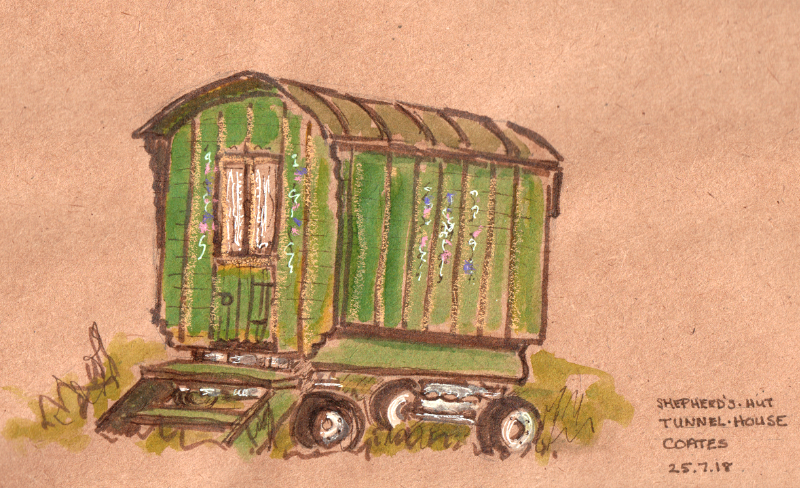
A canal, a tunnel and a bit of history

Wednesday, 25th July - A grand day out with a local sketch group at a hidden-away gem in the Gloucestershire countryside.


Seemingly in the middle of nowhere, at the end of a long, narrow gravel track is The Tunnel House Inn, surrounded by fields and shady, woodland areas.  Steps down a steep slope lead to a long disused canal and a grand Georgian style tunnel entrance, known as the Coates Portal.


The Sapperton Tunnel was constructed in 1784-9 and, at over 2 miles, was the longest ever built at the time.  The tunnel was too narrow to accommodate a tow path for the horses which pulled the barges, therefore a couple of men would lay on their backs on the front of the barge and "walk" their way along the walls, hence earning the name "leggers".  Meanwhile, the horses had to be led overground to meet up at the other end of the tunnel at Daneway.

The Tunnel House originally served as a hostel for the construction workers, but once the canal was in use it became a place for refreshment.  Traffic through the tunnel ceased in 1911 and subsequent roof falls made it impassable.  The portals at both ends were restored in the 1970s, but efforts to restore the weak areas of the interior seem to have been abandoned.


My sketches were done with sepia fine liner, watercolour, gouache, wax crayon and white gel pen.


Saturday, 3 February 2018

February Sketch Outing

A very damp, grey day, but our local sketching group had permission to use Swindon's old Town Hall building which now serves as a dance/drama studio.  Unfortunately, we weren't able to sketch any of the activities taking place - lots of youngsters milling about coming and going from their various classes within the building.  We were restricted to the foyer and the first floor landing, with most of us taking in the architectural and stained glass window details, although one or two took advantage of the framed photos of ballet dancers to try out some figure studies.

Watercolour, pen and oil crayon on Hahnemuhle grey paper -
I've only hinted at the complexity of the stained glass window
Watercolour marker and oil pastels
Marble statue of Charlotte Corday -
 by 19th Century sculptor Mich' Ioretti
This beautiful and unusually posed statue greets you in the entrance hall.  I'm afraid my photo is very out of focus, and my brief pencil sketch doesn't do her justice.


During the French Revolution, Charlotte was executed at the age of 25 for the assassination of the Jacobin leader, Jean-Paul Marat.  She believed she could save thousands of lives by ridding France of the more radical and violent faction of the Revolution.